AI / 09 of 09
Web Scrapers
Put a scraper on a webhook and call it from anywhere in your business — point it at a job listing, a rental listing or an invoice, name the fields you want, and get them back in the shape your systems already expect.
How it runs
Trigger
A URL hits the webhook
Step 01
Fetch and render the page
Step 02
Read the whole page
Step 03
Structure the fields you asked for
Step 04
Match to the record you hold
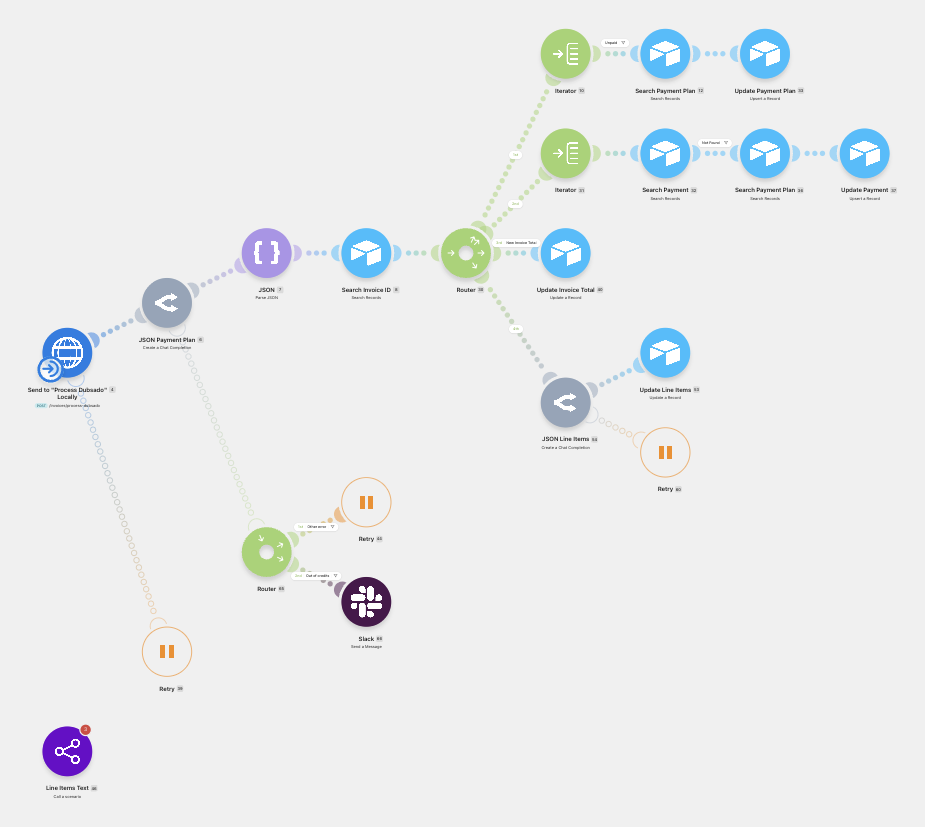
Routes — 4 ways
- Payment schedule
- Payment received
- Invoice total
- Line items
Only the fields that changed get written
Outcome
Lands in the shape you asked for
What it is
A scraper that lives on a webhook: send it a page, tell it which fields you want, and get them back in the shape your systems expect.
You need this if someone on your team opens a listing or an invoice and retypes what they find into a record, because that job grows with the business and never gets faster.
Every retype is a chance to put a wrong number into the record everything downstream trusts.
If you already run automations, anything with a URL becomes a source they can read.
The actual build
What it does for you
One scraper, pointed anywhere: job listings feeding a hiring pipeline, rental listings feeding realtor outreach, vendor invoices feeding the finance board — same webhook, a different field list, no second build
It reads the page itself rather than a picture of it
so the figures come back exact instead of near-enough, and nobody is checking a scanner's guesses against the original.
Because it answers on a webhook, every system you own can call it, and the reading job stops scaling with volume — twenty pages a week and two hundred cost you the same
Built and running
The Makenzie House
Fallon Scott, co-ownerLiveA CPA and former auditor running a wedding venue and photography studio, moving 20 to 50 vendor invoices a week across florists, caterers, tent and mobile bar suppliers, every one of them read by hand.
We didn't have one centralized place to say, this is the invoice. It's matched with this client. And it's due on this date. And we've already paid 20%.
What that cost her, in her words:
What if this vendor sent us the invoice twice in the email? … What if we're overpaying?
What worried her was the risk sitting inside it:
Every invoice is now read on arrival and filed against the right client with its total, its payment schedule and its line items. That is what makes the financial dashboards true rather than approximate — a real receivables position rather than a quote count, and a view of what is coming in against what is going out that she can hire and give raises against.
I have one place now with the dashboards to see everything I need to see from an owner perspective.
Her verdict:
Built while the business scaled from 2 to roughly 40 staff, on track to 10× revenue.
How to build it
- Start with one page somebody reads by hand every week, and write down the exact fields they copy off it
- Put the scraper behind a single webhook so anything in the business can call it, rather than building one per system
- Have it return those named fields and nothing else, so what comes back lands in a record without a person reading it first
- Match every result against the record you already hold before writing, which is what stops duplicates and overpayments
- Point the same webhook at the next page type and you are only writing a new field list, not a new scraper
Want this one built into your business?
Thirty minutes, no deck. We map what you run today and tell you what it would take.